Assessment Task: You will create a portfolio that documents your work from the labs and an accompanying reflective report that analyses your learning process.
4ENG002 Professional Engineering Skills Assessment 2 Brief - Portfolio and Report
| Academic Year | 2025/26 |
|---|
ASSESSMENT REQUIREMENTS
Course Name | All Engineering Pathways | ||
Module Title | Professional Engineering Skills | ||
Module Code | 4ENG002 | ||
Module Start Date / Cohort | September 2025 | ||
Module Level | 4 | Assessment Type(s) | Coursework/Report |
Word Length / Duration | Portfolio and Report – 750 words | % weighting | 50% of the module |
Deadline (date & time) for Submission | 2 pm, Thursday 11th | Format/Location | Word or PDF of the document in Turnitin |
WHAT TO SUBMIT:
A single PDF document that combines your portfolio and reflective report.
Assessment Feedback
- On Turnitin
Detailed Assessment Guidance
This assessment is a comprehensive and personal reflection on your journey through the module. You will compile a portfolio of your practical work and, more importantly, reflect on the learning that occurred. This isn't just about showcasing your successes; it's about demonstrating your growth as an engineer by analysing what worked, what didn't, and why.
- Assessment Task: You will create a portfolio that documents your work from the labs and an accompanying reflective report that analyses your learning process.
Portfolio and Report Content
Your submission should be a seamless combination of visuals and analysis, showing a holistic view of your learning.
- The Portfolio: This section should be a collection of images, sketches, and other visual evidence of your practical work from the module. You are encouraged to include photos of components you designed and fabricated, technical drawings, or any other visual evidence of your projects. You must reference each image within the body of your report. For example, you might write: "The finished component, shown in Figure 1, demonstrates the accuracy of the milling process."
- The Reflective Report: The 750-word report should be a personal narrative of your learning. You should not just describe what you did, but critically reflect on your experience. You can structure your report around the following key points:
oHighlights: Discuss one or two key pieces of work you are proud of. Explain the process, the skills you applied, and what you learned. Use your portfolio images to illustrate these points.
oChallenges and Problems: A crucial part of this report is to discuss things that did not go to plan. Describe a problem or an issue you faced—perhaps a tool broke, a measurement was wrong, or a design didn't work as expected.
oProblem-Solving: Explain the steps you took to overcome the problem. How did you diagnose the issue? What solutions did you try? This demonstrates your ability to think critically and adapt under pressure.
oOverall Learning: Conclude by summarising your key takeaways from the module's hands-on activities. Reflect on how your skills and your engineering approach have evolved since the start of the module.
Generative Artificial Intelligence (GenAI) and Assessments
Before approaching any assessment you should read the student guidance on the use of GenAI: Welcome to your generative AI guidance
This will ensure you are aware of the ethical, legal and learning aspects of using GenAI for your studies. Each module’s assessments will require a different approach to the use of Generative Artificial Intelligence (GenAI). Your Module Lead has evaluated this module’s assessment(s) using the Artificial Intelligence Assessment Scale (AIAS).
You can learn more about the AIAS at aiassessmentscale.com.
If you would like to understand more about how CCCU’s staff understand the use of GenAI in your learning, you can read the Staff Guidance.
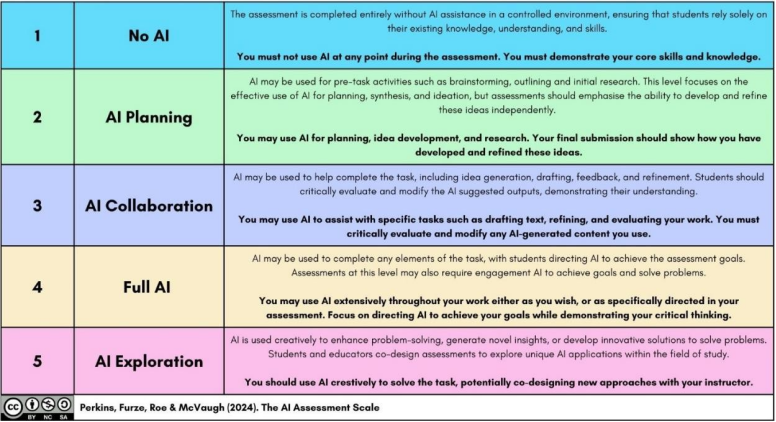
Your Module Lead has evaluated this module’s assessments as requiring the following level of interaction
with GenAI:
Assessment 2: Level 3 -AI Collaboration
At CCCU all assessments require a declaration regarding the level of GenAI use.
Under CCCU’s Academic Integrity Policy unacknowledged inclusion of GenAI is considered academic misconduct.
See the Academic Integrity and Misconduct webpages for more information.
Please select the most appropriate statement from the choice below and insert it at the start of your work:
a.No GenAI was used in the preparation, planning or creation of this work. [AIAS Level 1]
b.I acknowledge the use of outputs from [insert the name of generative AI tool(s) used] in the learning, preparation, planning or proofreading of this work. [AIAS Level 2]
c.I acknowledge collaboration with [insert the name of generative AI tool(s) used] in this work, and the inclusion of outputs in modified form. [AIAS Level 3]
d.I acknowledge [insert the name of generative AI tool(s) used] as partner(s) in the creation of this work. [AIAS Levels 4 & 5]
Referencing GenAI
If your assessment is rated at levels 2, 3 or 4, you are required to reference where you have used GenAI outputs in the body of your work. For guidance on how to reference GenAI in your work see Cite Them Right 13th Edn, or later. You can use the textbook or visit the Cite Them Right website – both are accessible via LibrarySearch (for the web version, login using your CCCU email).
You can speak to your module tutor, module lead, subject Librarian or Learning Developer for more guidance on the use of GenAI in your learning and assessment
Referencing
For the University guide to referencing use this link Introduction to referencing.
Marking Criteria
At the end of the document.
Further Information
Recordings and Presentation Slides from Lectures and Practical Workshops relevant to this Assessment will be available on the Learning Resources tab on the Module Blackboard.
4ENG002 Marking Rubric
Marks for the separate areas are typified by grades indicated below. All marks can be adjusted up or down for poor or good practice not mentioned in the scheme.
CRITERION | 100-80 Excellent | 79-70 Very good | 69-60 Good | 59-50 Sound | 49-40 Satisfactory | 39-20 Fail | 19-0 Fail |
A. KNOWLEDGE & UNDERSTANDING | |||||||
1. Knowledge and | Knowledge and understanding | Demonstrates an accurate, | Shows a systematic and | Sound descriptive | Selection of theory is | In this assignment some | In this assignment there |
application of | of theory are detailed and | systematic theoretical | accurate understanding of | knowledge of key theories | satisfactory, and | of the theories | is a lack of relevant |
subject and | beyond what has been taught. | understanding of the | key subject-specific | with appropriate | terminology, facts and | presented are not | subject-specific theory. |
theories (20%) | Appreciation of the limits of | subject and a range of key | theories, which are | application; sometimes | concepts are handled | appropriate. |
|
| subject-specific theories | theories. Appropriately | appropriately integrated | balanced towards the | accurately, but application | Terminology, facts, and |
|
| demonstrated in the work. | selected theoretical | within the context of the | descriptive rather than | and understanding are | concepts are presented |
|
| Approach to assessment task is | knowledge is synergised | assessment task. | the critical or analytical. | generalised. | inaccurately and/or with |
|
| clearly, appropriately, and | into the overall assessment |
|
|
| omissions in key areas. |
|
| theoretically informed. | task with some |
|
|
| The application and/or |
|
|
| appreciation of the limits of |
|
|
| understanding |
|
|
| subject specific theories. |
|
|
| demonstrated is |
|
|
|
|
|
|
| extremely limited. |
|
2. Evaluation of | Evaluates information and/or | Evaluates information | Effectively evaluates | Shows sound, basic | Shows basic evaluation of | In this submission, | The work shows limited |
process and the | data and the inquiry process | and/or data and the inquiry | information and/or data | evaluation of information | the inquiry methodology | evaluation of process | or no evaluation of |
quality of information / data developed (20%) | perceptively using appropriate criteria some of which is self- determined. | process perceptively using appropriate criteria some of which may be self- | and the inquiry process using prescribed guidelines. | and/or data and the inquiry process used. | and information and/or data generated. | and the information and/or data is incomplete. | either process or outcomes. |
|
| determined. |
|
|
|
|
|
3. Clarity of | This work defines appropriate | This work defines | This work defines | This work outlines some | This work uses generalised | In this piece of work | In this piece of work no |
objectives and | objectives in detail and | appropriate objectives in | appropriate objectives | appropriate objectives | objectives to provide | objectives are not | objectives are identified, |
focus of work (20%) | addresses them logically, coherently, comprehensively showing sophisticated | detail and addresses them logically, and coherently, interpreting complex ideas clearly. | and addresses them coherently and logically throughout the work providing a clear focus to | and addresses them in a coherent manner which gives focus to the work. | adequate but limited focus to the work | appropriate and/or clearly identified – focus is not logical or coherent. | and the submission lacks focus and coherence. |
|
|
| the work. |
|
|
|
|
Reflection (including | Confidently evaluates own strengths and weaknesses and the criteria by which such judgements are made. Starts to interrogate received opinion,prejudices and value sets operating. | Confidently evaluates own strengths and weaknesses and Prepared to question received opinion, prejudices and | Able to evaluate own strengths and weaknesses and shows | Demonstrates an understanding of the criteria set by others. Recognises own strengths and weaknesses in | Dependent on criteria set by others. Begins to recognise own strengths and weaknesses in relation to these criteria. Does not question received opinion. | Partial awareness of criteria set by others and limited ability to evaluate own strengths and weaknesses in relation to them. | Work does not apply criteria set by others or show recognition of own strengths and |
Communication and | Effective and polishedcommunication which demonstrates a strong andsophisticated understanding of the discipline. | Accomplished communication in a format appropriate |

